
The Male Loneliness Epidemic No One Talks About in Relationships
Part 1 of a 4-part series on male loneliness, emotional withdrawal, and relationship reset.
Jim* lives in Yorktown Heights with his wife Jane*. They’ve built a life that, from the outside, looks steady. Careers, home, family, responsibilities handled. The kind of life people assume is working.
What isn’t visible is the kind of loneliness that can exist inside a relationship. Not isolation in the traditional sense, but a quieter form of disconnection. The kind where someone is present in every way that can be seen, but not fully known.
When he sits down in my office, nothing about him suggests something is off. He’s composed, articulate, used to being in control of his environment. But when the conversation shifts away from work and into something more personal, there’s a moment where the energy changes.
“I don’t really have anyone I can talk to,” he says.
It doesn’t come out as a complaint. It lands more like a realization.
Jane turns and looks at him, genuinely surprised. From her perspective, that doesn’t make sense. He’s constantly around people. His phone is always active. There are colleagues, acquaintances, people he sees regularly. There is no visible absence of connection.
But what he’s describing has nothing to do with being around people.
It has to do with not being known.
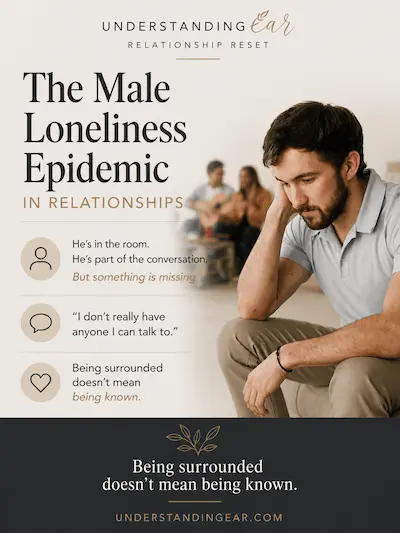
Male Loneliness Doesn’t Always Look Like Isolation
We are living in what has been widely described as a male loneliness epidemic, but the way it shows up in men is often misunderstood. It doesn’t always look like isolation. More often, it hides inside full lives, structured routines, and constant engagement with others. Men are not necessarily alone. They are just rarely in spaces where anything real is being said.
Jim knows how to navigate a boardroom. He knows how to make decisions under pressure, how to problem-solve, how to carry responsibility without hesitation. What he doesn’t know how to do, and what no one ever really taught him, is how to stay in a conversation when the subject turns inward. When the question is no longer about what needs to be done, but about what he is actually feeling.
So when something feels off, he does what he has always done. He keeps moving. He tells himself it’s not a big deal. He waits for it to pass.
From his perspective, that is strength. From Jane’s perspective, it feels like distance.
Why Men Feel Disconnected in Relationships
Jane has been trying to reach him for a long time. Not because he isn’t physically present, but because something in him isn’t available. When she asks what’s wrong, he tells her nothing is wrong. When she pushes, he either shuts down or shifts the conversation somewhere safer. Over time, she stops asking in the same way, but the question doesn’t go away. It just sits there, unanswered.
This is where the disconnect between men and women in relationships becomes most visible. Not in conflict, but in absence. In the space where something should be happening and isn’t.
There’s a tendency to explain this kind of disconnection by pointing to what’s missing. Not enough attention. Not enough time. Not enough effort. Sometimes those things are true. But they are not the root of the problem.
The deeper issue is that many men have learned how to function without ever being fully seen.
The Hidden Cost of Emotional Isolation in Men
Most men have relationships built on shared activity, shared history, or shared responsibility, but very few where the expectation is honesty without performance. The kind of friendship where someone looks at you and asks a question that can’t be answered quickly, and then stays long enough to hear what comes after the pause.
Without that, everything stays at the surface.
And what isn’t expressed doesn’t disappear. It redirects.
In relationships, that redirection can take different forms. Sometimes it shows up as withdrawal. Sometimes as irritability. Sometimes as silence that becomes harder and harder to break. And in some cases, it shows up in ways that cause real damage, not because the intention was to hurt, but because the disconnection was never addressed directly.
How Male Loneliness Impacts Marriage
When I sit with men like Jim, there is rarely a lack of care. What’s missing is the ability to stay present when something feels uncomfortable, uncertain, or emotionally unfamiliar. There is no practice for it. No language for it. And without that, even strong relationships begin to feel strained.
Back in the session, Jane says something simple.
“I just want to feel like I matter to you.”
Jim nods. He means it.
But intention and experience are not the same.
He’s been showing up in the ways he understands. Providing. Being present. Keeping things moving. But what Jane is asking for requires something different. Attention. Presence. Emotional availability.
And those are the exact areas where he feels least equipped.
Where Relationship Reset Actually Begins
This is also where most couples misunderstand what needs to happen next.
They come in focused on each other.
What wasn’t said.
What wasn’t done.
What should have been different.
And those things matter.
But they’re not where the reset begins.
Because what’s happening between them is being shaped by something happening within each of them.
When couples come to me, often as an alternative to traditional marriage counseling or therapy, they’re usually trying to move forward quickly. They want answers. Direction. A sense of whether this can work.
What I do instead is slow everything down.
Not to delay progress, but to make sure they’re actually seeing what’s there.
Because underneath the disconnection between them, there are individual patterns that have been running for years.
Patterns like avoidance, over-accommodation, silence, and assumption start to surface. Ways of coping that once felt functional but are now creating distance.
In Jim’s case, his loneliness didn’t start in the marriage. It showed up there.
His tendency to keep things to himself, to push through, to not name what felt off, those patterns were already in place. The relationship simply became the place where the impact was most visible.
Jane has her own patterns as well. Ways she reaches, ways she interprets, ways she reacts when she feels that distance.
And when those patterns meet, they don’t resolve each other.
They amplify.
That’s when couples start to feel like they’re breaking.
Not because something suddenly went wrong, but because what’s been there all along is no longer being absorbed or ignored.
A relationship reset isn’t about going back to what they had.
It’s about seeing clearly what’s actually happening, individually and together, and deciding what gets carried forward and what doesn’t.
Because until each person can recognize their own patterns without immediately shifting focus to the other, the dynamic doesn’t change.
It just repeats.
And over time, that repetition is what turns loneliness, on both sides, into something much harder to come back from.
What Needs to Change
Closing what some refer to as the “Brotherhood Gap” is not about adding more people into a man’s life. It’s about changing the quality of at least one conversation. It’s about creating space where there is no need to perform, no expectation to have the answer, and no pressure to resolve everything immediately.
It starts with something simple, but not easy.
Being honest about what is actually happening.
Not once everything has been figured out, but while it is still unclear.
For many men, that is unfamiliar territory. It requires letting go of the idea that they are supposed to have it handled and allowing someone else to see them without that layer in place.
But that is also where connection lives.
The Part That Usually Gets Avoided
At the end of everything, the measure of a life is not how much was achieved or how much was managed. It is whether there were relationships where something real was shared and sustained over time.
Because loneliness, especially for men, is not always about being alone.
It is about living in a world where no one is close enough to see what’s actually there.
And continuing to move through life as if that absence doesn’t matter.
*names changed to protect privacy - story used with permission.
FAQ: Male Loneliness and Relationships
Why do men feel lonely even when they have friends?
Because most of their relationships stay at the surface, built around activity rather than honesty.
What is the male loneliness epidemic?
It refers to the increasing number of men who feel emotionally isolated, even while maintaining social and professional relationships. The issue is less about being alone and more about not being known.
Why do men struggle to open up emotionally?
Many men were never taught how to express emotional discomfort. Strength was often defined as independence and self-reliance, which leaves little room for vulnerability.
How does male loneliness affect relationships?
It creates distance. Partners often feel shut out or disconnected, even when everything appears functional on the surface. Over time, this can lead to resentment, withdrawal, or deeper relational breakdowns.