Forgiveness as a Healing Process: Healing the Pain of Betrayal and Rebuilding Bonds
Forgiveness After Betrayal: What It Does and Doesn't Mean
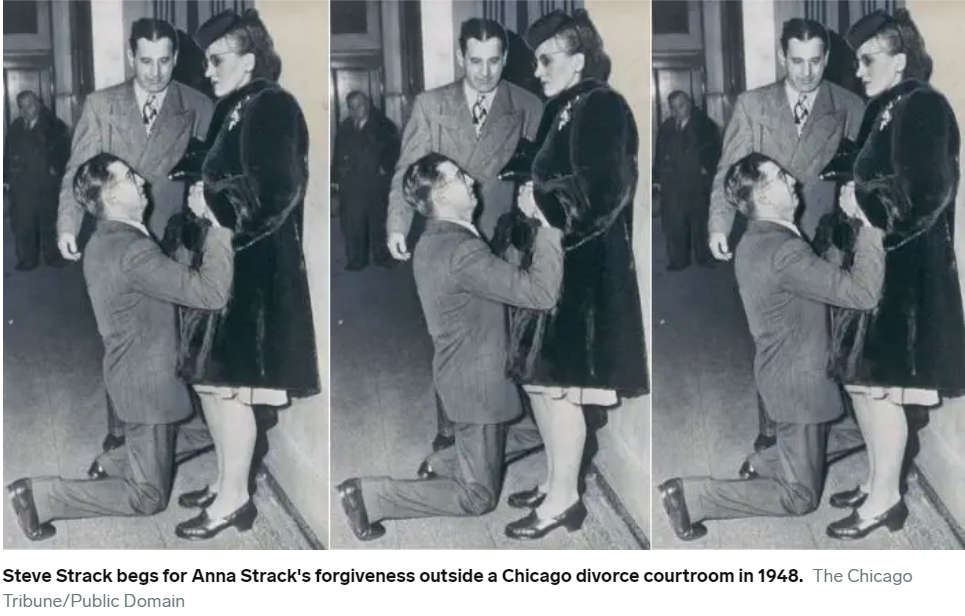
There is a photograph from 1948 that has stayed with me.
Steve Strack is outside a Chicago divorce court, on his knees, holding his wife Anna's hands and begging her for forgiveness.
Not metaphorically.
He is literally on his knees begging her not to end their marriage.
Anna had filed for divorce citing his habitual drunkenness. They had a young son together. There was history between them, a family between them, and now there was this very public moment of a husband pleading with his wife for another chance.
She still said no.
That is what makes the photograph so powerful to me.
We are taught to think of forgiveness as the thing that comes after someone is sorry enough.
They apologize. They show remorse. They beg. And somewhere in there, the person who was hurt is expected to soften.
But Anna's decision reminds me of something I see in betrayal recovery all the time.
Someone else's remorse does not make your decision for you.
A person can be genuinely sorry and you can still decide not to stay. They can ask for forgiveness and you can still need accountability. They can beg for another chance and you can still decide that another chance is not what you want.
And perhaps most importantly, forgiveness and reconciliation are not the same decision.
Forgiveness Does Not Require Reconciliation
After betrayal, people often get these two things tangled together.
If I forgive them, does that mean I have to stay?
No.
If I stay, does that mean I have to forgive them now?
No.
If they are truly remorseful, am I wrong for still wanting to leave?
No.
Forgiveness does not obligate you to rebuild a relationship. Rebuilding a relationship does not require you to manufacture forgiveness before you actually feel it.
Those are separate decisions.
And when someone is standing in front of you asking for another chance, especially when you can see their remorse, separating those decisions can be incredibly difficult.
Because now you are not only carrying your own pain.
You are watching theirs.
I have seen people become so focused on whether their partner is sorry that they lose sight of the question they actually need to answer.
What do I want?
Remorse matters.
It just doesn't make that decision for you.
An Apology Is Not the Same as Rebuilding Trust
A sincere apology matters.
So does remorse.
But neither one erases what happened.
After betrayal, I often see one person reach a point where they genuinely understand the damage they caused. They apologize. They answer questions. They say they would take it back if they could.
And then they become confused when their partner is still hurting.
"I said I was sorry."
"I've answered everything."
"What else can I do?"
The answer is usually not another apology.
The person who was betrayed is watching what happens after the apology.
Does honesty continue when the conversation becomes uncomfortable? Does accountability remain when nobody is asking for it? Do the words and behavior begin matching consistently enough that the relationship starts feeling more predictable again?
That is where rebuilding happens.
An apology can acknowledge what happened.
It cannot rebuild trust by itself.
Forgiveness Does Not Mean What Happened Was Okay
Sometimes people resist forgiveness because it feels like letting the other person off the hook.
I understand that.
If forgiveness means pretending the betrayal wasn't devastating, I wouldn't want that version either.
You do not have to minimize what happened in order to stop carrying it in exactly the same way.
You do not have to rewrite the past.
You do not have to call something acceptable when it wasn't.
And you certainly do not have to protect the person who betrayed you from the consequences of their own choices.
Forgiveness, when and if it comes, does not change what happened.
It changes your relationship to what happened.
That may take time.
It may also look very different from what you thought forgiveness was supposed to look like.
What About Forgiving Yourself?
This is the part people don't talk about nearly enough.
After betrayal, people can become incredibly hard on themselves.
How did I not know?
Why did I believe them?
Why did I stay?
Why didn't I leave sooner?
Why am I still thinking about this?
Why can't I move past it?
There can be an enormous amount of self-judgment layered on top of something that was already painful.
I know this personally.
There were things I questioned about myself after betrayal that had very little to do with the decision someone else made and everything to do with trying to make sense of something I could not yet understand.
Eventually I had to separate two very different questions.
What do I want to understand about myself and my relationship?
And:
What am I taking responsibility for that was never mine to carry?
Those are not the same thing.
The decision to betray belongs to the person who made it.
That does not mean there is nothing to examine in the relationship. If you choose to rebuild, there may be plenty to understand about how the two of you communicated, disconnected, avoided, assumed, or stopped bringing parts of yourselves to each other.
My husband and I had things we needed to look at if we were going to rebuild differently.
His betrayal was still his choice.
Both things can be true.
You Don't Have to Rush Forgiveness
I am far more interested in clarity than I am in getting someone to forgive on a particular timeline.
What are you actually feeling?
What still needs to be understood?
Has responsibility been taken?
Has behavior changed?
Is trust beginning to return?
Do you want this relationship?
What would rebuilding require from both of you?
Those questions matter whether forgiveness comes tomorrow, two years from now, or takes a form you never expected.
Sometimes people want to forgive because they are tired of being angry.
Sometimes they want to forgive because their partner is desperate for them to.
Sometimes they think forgiveness is the requirement for moving forward.
I don't think you need to force yourself into any of those positions.
You need enough clarity to understand what forgiveness means to you and whether it has anything to do with the decision you are trying to make.
The Choice Still Belongs to You
I keep coming back to that photograph because Steve is doing almost everything we associate visually with remorse.
He is on his knees.
He is holding her hands.
He is begging.
And Anna still gets to choose.
That does not tell us she was unforgiving. It does not tell us she did not love him. It does not tell us what she felt standing there.
It tells us something much simpler.
His remorse belonged to him. Her decision belonged to her.
That distinction matters after betrayal.
From the outside, people see moments.
The apology.
The remorse.
The betrayal.
The decision to stay.
The decision to leave.
You are the one who has to live with what comes after.
Forgiveness may become part of what comes next.
Reconciliation may become part of it too.
Or it may not.
The goal is not to arrive at the answer someone else thinks you should choose. It is to understand clearly enough what happened, what is happening now, and what you are willing to build from here.
Next Steps
If you are navigating betrayal and trying to understand what rebuilding would actually require, explore Betrayal Recovery.
If you are unsure what comes next, schedule a Foundation Session.
If curious, here is the photograph: